
Updated September 30, 2026 | For consumers, brands, distributors, retailers and OEM/ODM buyers
If you search for the best magnetic power bank, MagSafe-compatible battery pack, Qi2 power bank or travel portable charger, one decision appears again and again: 5000mAh or 10000mAh? The answer is not simply “bigger is better.” Capacity changes thickness, weight, thermal design, charging behavior, price, product positioning and how comfortable the battery feels when it is attached to a phone.
For consumers, the decision is about convenience versus reserve power. For brands and distributors, it is also a portfolio decision: do you launch an ultra-slim 5000mAh magnetic power bank, a higher-capacity 10000mAh magnetic power bank, or both as a two-tier product line? This guide explains the trade-offs and shows how HSONE maps both capacities into Qi2, Qi2 25W, smart-display, semi-solid, built-in-cable and value product platforms.
The short answer
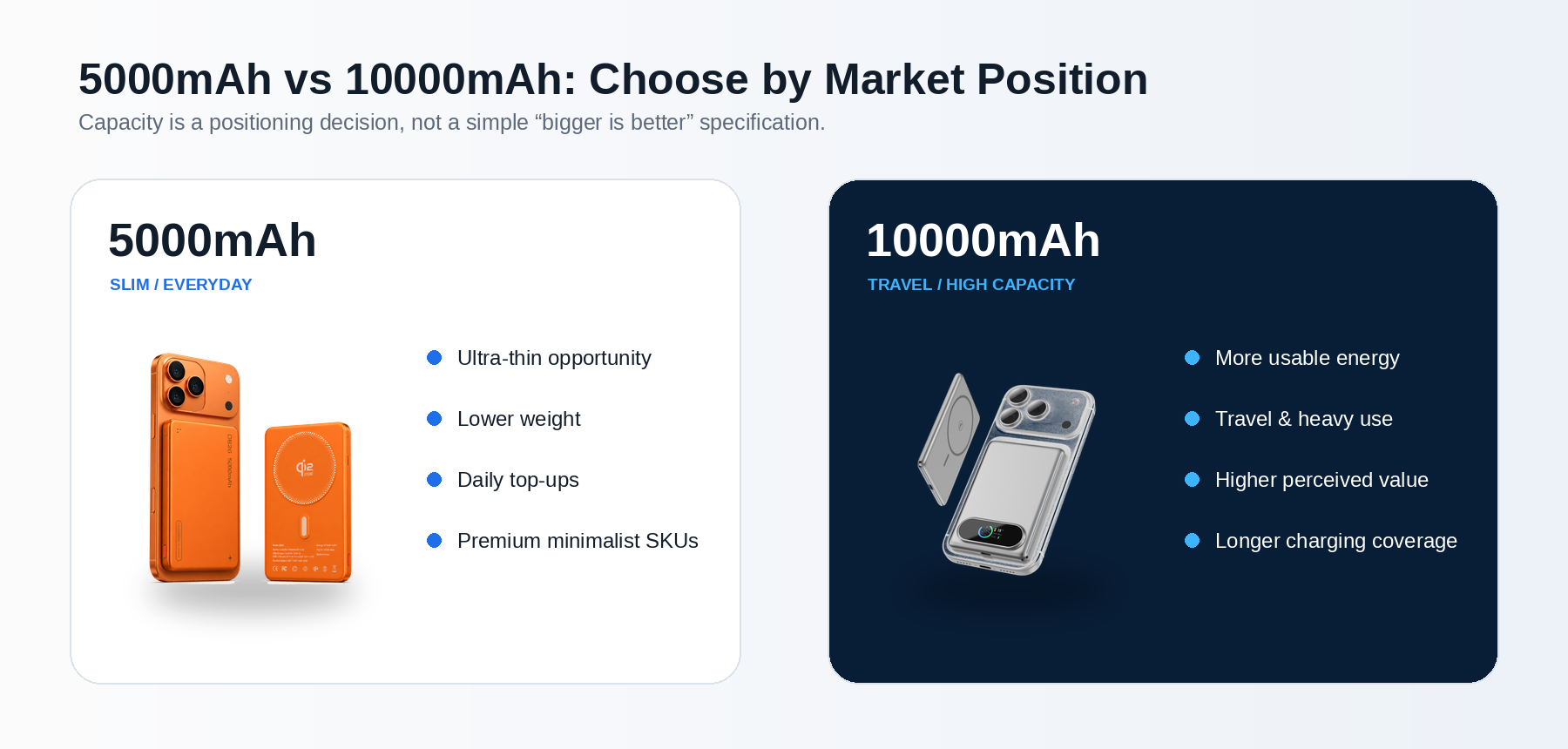
Choose 5000mAh when thinness, weight, pocketability and emergency top-ups are more important than maximum runtime. Choose 10000mAh when the customer expects an all-day backup, frequent travel, heavy navigation or photography use, or wants more feature headroom such as higher wired output and built-in cables.
For most B2B brands: 5000mAh works well as the slim/everyday SKU; 10000mAh works well as the travel/high-capacity SKU. Offering both creates a natural Good / Better ladder.
| Decision Factor | 5000mAh Magnetic Power Bank | 10000mAh Magnetic Power Bank |
| Primary advantage | Slim, light, easy to keep attached | More reserve energy and fewer charging decisions |
| Best use | Commute, workday top-ups, pocket carry | Travel, long days, navigation, heavy use |
| Typical product story | Ultra-slim / minimalist / premium daily carry | Travel / all-day / feature-rich |
| Design pressure | Minimize thickness and weight | Balance capacity with thickness and ergonomics |
| B2B role | Entry or premium slim SKU | Higher-capacity / higher-ASP SKU |
1. First, understand what 5000mAh and 10000mAh actually mean
The mAh number describes the nominal charge capacity of the internal battery cell at its cell voltage. It is not a promise that the same number of mAh will appear inside the phone battery. A power bank must convert its cell voltage to the voltage used by USB-C or the wireless charging system, and every conversion step has losses.

This is why professional product specifications often include both battery capacity in mAh and energy in watt-hours (Wh), plus a rated output capacity under a defined voltage and current. Several HSONE 3.85V platforms, for example, specify 5000mAh as 19.25Wh with a rated capacity of 3000mAh at 5V/2A, and 10000mAh as 38.5Wh with a rated capacity of 6000mAh at 5V/2A.
Those numbers still do not translate into a fixed number of phone recharges. Real results vary with phone battery size, state of charge, cable quality, wireless alignment, temperature, charging protocol, conversion efficiency and how the phone manages power while it is being used.
mAh vs Wh: which number is more useful?
For comparing power banks built with different cell voltages, Wh is the cleaner energy measurement because watt-hours combine voltage and capacity. For retail marketing, mAh remains the familiar consumer number. A professional datasheet should make both clear.
2. When a 5000mAh magnetic power bank is the better choice
A 5000mAh magnetic power bank is strongest when the customer wants a battery that feels like a phone accessory rather than a second device attached to the phone. The category is especially attractive for daily commuting, coffee-shop work, conferences, shopping, festivals and other situations where the phone mainly needs a top-up rather than multiple complete recharge cycles.
Recent Reddit discussions from travelers and magnetic-power-bank users repeatedly describe the 5000mAh model as “insurance” against running out of battery. Users who value one-bag travel, slim pockets and low weight often prefer the smaller capacity even while acknowledging that wireless charging is less energy-efficient than a cable.
Why 5000mAh sells well in premium magnetic charging
- Lower weight makes the phone easier to hold while the battery is attached.
- Thinner housings create a more premium visual story for Apple-accessory and lifestyle channels.
- Less volume behind the phone reduces interference with pockets, grips and small handbags.
- It is easier to position as an always-with-you emergency battery rather than a travel brick.
- It can support a lower entry price while still carrying premium features such as Qi2, a TFT display or an aluminum shell.
3. When 10000mAh is the better magnetic power bank capacity
A 10000mAh magnetic power bank is better when the buyer values runtime over minimum thickness. Typical users include travelers, delivery drivers, content creators, field workers and anyone who relies on a phone for navigation, photography, payments, boarding passes and communication for many hours away from an outlet.
Recent Reddit travel threads show the exact trade-off: some users prefer a 5000mAh magnetic pack because it disappears in a pocket, while others choose 10000mAh because the extra reserve is worth the added weight on long transit days. Built-in USB-C cables are frequently mentioned as a reason a larger power bank can still simplify the overall charging kit.
Why 10000mAh can support a richer feature set
- More reserve energy for long days and repeated top-ups.
- More room in the product architecture for higher-power wired output on selected platforms.
- Better fit for built-in cable, stand and smart-display product concepts.
- Stronger travel and “all-day power” marketing story.
- Higher perceived value can support a higher retail price when the design remains compact.

4. Magnetic wireless charging changes the capacity decision
A magnetic power bank is not the same as a traditional wired power bank. Wireless charging adds convenience because the battery can snap directly to the phone, but the charging system must move energy through a transmitter coil, air gap and receiver coil before it reaches the phone. That makes alignment and thermal management especially important.
The Wireless Power Consortium explains that Qi2 uses magnetic alignment so the transmitter and receiver coils sit in the correct position, improving energy efficiency and charging consistency. Better alignment also reduces energy that would otherwise be lost as heat when the coils are offset.
Read the WPC explanation of magnetic alignment →

What buyers are discussing right now
The most useful community discussions are not asking only “Which capacity is bigger?” They are asking whether the product is comfortable to hold, whether it becomes too warm in a pocket, whether a built-in cable eliminates a loose cable, whether Qi2 25W makes a noticeable difference, and whether 10000mAh is worth carrying every day. These are strong clues for product-development and SEO positioning, although community comments should be treated as anecdotal market signals rather than laboratory evidence.
5. Qi2 15W vs Qi2 25W: does faster wireless charging change which capacity you should buy?
Qi2 and Qi2 25W add another layer to the decision. The Wireless Power Consortium says original Qi2 supports up to 15W, while Qi2 25W increases the available power and uses certified magnetic alignment for interoperability and performance. Higher wireless power can make short charging sessions more useful, but it also raises the importance of thermal design.
For a 5000mAh model, Qi2 25W can strengthen the “fast top-up in a slim body” story. For a 10000mAh model, Qi2 25W can combine fast wireless charging with enough reserve for travel. In both cases, B2B buyers should check real temperature curves and device compatibility rather than assuming that maximum wattage is sustained continuously.
Read HSONE’s Qi2 vs Qi2 25W guide →

6. A real HSONE example: what doubling capacity does to size and weight
The capacity trade-off becomes much clearer when two related products use a similar technology story. In HSONE’s semi-solid / smart-display platform, C18 is a 5000mAh model specified at approximately 6.7mm and 95g. C18 PLUS is a 10000mAh model specified at approximately 12mm and 166g, with additional wired-output headroom up to PD45W on that platform.
The important point is not that one is better. C18 is easier to sell around ultra-slim daily carry. C18 PLUS is easier to sell around longer endurance and higher wired performance. The same design language can serve two different buyer priorities.
7. 5000mAh vs 10000mAh for iPhone, Android and smaller phones
Phone size matters. A compact magnetic power bank that sits comfortably behind a large phone may extend below or around the edges of a smaller device. Reddit users with compact Android phones have specifically raised this issue when considering 10000mAh magnetic packs. For B2B development, mechanical fit should therefore be tested on the actual device mix in the target market, not only on the latest large-screen iPhone.
Some Android devices support Qi2 directly, while “Qi2 Ready” phones may rely on a compatible magnetic case for alignment. That case changes the total gap, magnetic force and hand feel, so case testing should be included in the validation plan.
8. Built-in USB-C cable: why it can change the 5000 vs 10000 decision
A built-in cable can make a thicker 10000mAh model easier to justify. Instead of thinking only about the weight of the power bank, consider the weight and complexity of the entire charging kit. If the integrated cable replaces a separate cable, the larger power bank may simplify travel despite its higher battery weight.
The same idea also works at 5000mAh: a slim magnetic battery with an integrated USB-C cable gives users two charging modes. Wireless is available when convenience matters; wired charging is available when the user wants higher energy efficiency, lower heat or faster charging on a compatible device.
9. Is a 5000mAh magnetic power bank enough for travel?
It can be, if the power bank is used mainly as an emergency top-up and the traveler can recharge overnight. It is less suitable when the phone is expected to run navigation, hotspot, camera, social media and payment apps throughout a long day with limited access to wall power.
A practical travel rule is to choose 5000mAh when the goal is “never reach zero,” and 10000mAh when the goal is “avoid thinking about power for most of the day.” This is also why travelers who carry only a phone often debate 5K versus 10K more intensely than laptop users, who usually need a higher-power wired battery anyway.

10. Airline rules: both capacities are small, but travel compliance still matters
For typical HSONE platforms, 5000mAh is around 18.5–19.25Wh and 10000mAh is around 38.5Wh, both well below 100Wh. However, airlines and aviation authorities care about more than capacity.
IATA’s 2026 guidance reflecting ICAO changes states that power banks for personal use must be carried in carry-on baggage, limits passengers to no more than two power banks, prohibits recharging the power bank while onboard, and recommends that power banks not be used to recharge portable electronic devices in flight. It also emphasizes UN38.3 compliance and individual short-circuit protection. Implementation can vary by jurisdiction and airline, so passengers should check the operating carrier before travel.
IATA 2026 Guidance Document for Operators – Power Banks →

11. For B2B buyers: should your brand launch 5000mAh, 10000mAh or both?
For many brands, the strongest answer is both — but only if the two capacities have distinct jobs. A product line becomes confusing when the 5000mAh and 10000mAh versions look almost identical but have no clear reason to choose one over the other.
A clean two-SKU strategy
- 5000mAh = Slim / Everyday / Entry Premium: focus on thickness, weight, materials and effortless carry.
- 10000mAh = Travel / High Capacity / Feature Premium: focus on reserve energy, higher wired output, built-in cable or smart functions.
- Keep the industrial design and packaging family consistent so buyers immediately understand that the two models belong together.
- Use price spacing that makes the upgrade logical rather than forcing both products into the same retail position.
| Sales Channel | 5000mAh Role | 10000mAh Role | Recommended Strategy |
| Apple-accessory retail | Ultra-slim premium | Travel premium | Lead with 5K; upsell 10K |
| Amazon / e-commerce | High-conversion compact SKU | Feature-rich higher-capacity SKU | Offer both |
| Distributor | Entry and mid-range price point | Higher-value SKU | Offer both |
| Travel accessories | Backup / lightweight | Primary travel SKU | Lead with 10K |
| Corporate gift / promotion | Lower-cost branded option | Premium gift option | Choose by budget |
| Technology brand | Design-led platform | Performance-led platform | Build a family |

12. HSONE capacity pairs for magnetic power bank projects
HSONE already has multiple 5000mAh / 10000mAh pairs that can be used to build a coherent product ladder. This allows a brand to retain a similar design or feature story while serving different weight, runtime and price targets.
Examples include C1/C2, C03/C04, F20S/F20S PLUS, F15/F15 PLUS, MY15/MY25, DJ05/DJ10, C18/C18 PLUS, C43/C43 PLUS, DB26/DB27 and LX27/LX27 PLUS. The exact wireless standard, output, materials, size and feature set vary by model, so final selection should be based on the current datasheet and target market.
Explore HSONE magnetic power bank collections →
13. Capacity is only one filter — combine it with the feature story
High-performing product pages rarely sell a power bank on capacity alone. Search behavior shows that customers combine capacity with feature keywords. For SEO and product strategy, the most useful combinations include:
- 5000mAh ultra slim magnetic power bank
- 10000mAh slim magnetic power bank
- Qi2 magnetic power bank 5000mAh
- Qi2 25W power bank 10000mAh
- MagSafe-compatible power bank with built-in cable
- magnetic power bank with stand
- TFT display power bank
- semi-solid battery power bank
- aluminum magnetic power bank
- PD20W / PD45W magnetic power bank
- portable charger for travel
- custom logo magnetic power bank
This is useful for both SEO and product development: the capacity keyword attracts the buyer, while the feature story creates a reason to choose your SKU over a generic alternative.
14. OEM/ODM checklist: choose capacity before you lock the industrial design
For a custom magnetic power bank, capacity should be decided before industrial design is finalized because it affects battery thickness, PCB layout, coil position, product weight and thermal paths. A buyer who changes from 5000mAh to 10000mAh late in development may effectively be asking for a different product.
- Define the target user: commuter, traveler, heavy phone user or promotional customer.
- Set the target weight and thickness before selecting the cell.
- Decide whether wireless charging is Qi2 15W, Qi2 25W or another validated platform.
- Define wired USB-C output and whether the battery must recharge quickly.
- Decide whether the product needs a built-in cable, stand, TFT display or Apple Watch charging.
- Select materials and CMF: aluminum, magnesium alloy, glass or flame-retardant plastic depending on the model.
- Map required certification and transportation documentation before tooling.
- Build and test the golden sample on real target phones and cases.
15. What should an importer ask before ordering 5000mAh or 10000mAh magnetic power banks?
- What is the actual battery energy in Wh and the rated output capacity?
- What are the final product weight and thickness for each capacity?
- Is the model officially Qi2 / Qi2 25W Certified where claimed?
- What wired input/output protocols and maximum power are supported?
- Which phones and magnetic cases have been tested?
- What is the charging temperature under defined conditions?
- What battery cell supplier and protection architecture are used?
- Can the factory provide CE, FCC, RoHS, UL2056, CCC or other required market documentation?
- Are UN38.3, MSDS and air/sea transport documents available for the actual configuration?
- Can logo, packaging, color, TFT UI, firmware or structure be customized?
- What are MOQ, sample lead time and mass-production lead time?
Read HSONE’s full magnetic power bank manufacturer sourcing guide →
16. Does 10000mAh automatically mean more battery risk?
No. A larger battery stores more energy, but safety depends on cell quality, protection design, mechanical structure, charging electronics, thermal control, manufacturing consistency and compliance. A well-engineered 10000mAh product can be safer and more reliable than a poorly made 5000mAh product.
HSONE also offers selected semi-solid battery platforms for buyers who want a stronger battery-safety and premium-technology story. Semi-solid technology should still be evaluated with the same disciplined testing approach rather than treated as a guarantee against all failure modes.
Read the Semi-Solid-State Battery Power Bank Guide →
Frequently Asked Questions
Is 5000mAh enough for a magnetic power bank?
Yes for many daily-use scenarios. A 5000mAh magnetic power bank is best treated as a compact battery extender for commuting, workdays, events and emergency top-ups. Heavy users and travelers may prefer 10000mAh.
Is 10000mAh too heavy for a MagSafe-compatible power bank?
Not necessarily, but the design matters. A 10000mAh pack will usually be thicker and heavier than a related 5000mAh model. Buyers should compare actual grams, dimensions and how the product sits on the target phone.
Which is better for travel: 5000mAh or 10000mAh?
Choose 5000mAh for minimal carry when you can recharge most nights. Choose 10000mAh for long transit days, heavy navigation, photography and fewer opportunities to use wall power.
Does wireless charging use more of the power bank capacity?
Wireless charging has conversion losses in the charging system. Magnetic alignment in Qi2 improves positioning and can reduce avoidable losses, but real efficiency still varies with device, case, temperature and operating conditions.
Is a Qi2 25W 5000mAh power bank better than a Qi2 15W 10000mAh model?
They solve different problems. The 25W 5000mAh model emphasizes faster short top-ups and portability; the 10000mAh model emphasizes endurance. Compare the target use case rather than only one specification.
Can I take a 10000mAh power bank on a plane in 2026?
Typical 10000mAh phone power banks are well below 100Wh, but current IATA/ICAO guidance imposes additional carriage and onboard-use rules. Check the airline before travel because implementation and airline policies can differ.
What is the best capacity for an OEM magnetic power bank project?
For a premium slim product, 5000mAh is often easier to position. For travel and feature-rich products, 10000mAh is stronger. Brands with multiple channels often benefit from launching both.
Can HSONE customize both 5000mAh and 10000mAh models?
Yes. Depending on the selected platform, HSONE supports logo, color, CMF, packaging, smart-display UI, selected firmware and structural customization, plus private-mold development for qualified projects.
What is the difference between a 5000mAh magnetic power bank and a 5000mAh wired power bank?
The magnetic model includes a wireless charging system and magnets, which affect thickness, heat, cost and energy transfer. Many magnetic models also support USB-C wired charging, giving users both convenience and efficiency options.
Should a brand use the word MagSafe on product pages?
Consumers commonly search “MagSafe power bank,” but brands should describe compatibility and certification accurately. Do not imply Apple certification or use protected logos unless the actual product and marketing rights support those claims.
Final verdict: choose the capacity that matches the job
5000mAh wins when the product must feel slim, light and effortless. 10000mAh wins when the customer wants more reserve, longer days and a broader feature set. Neither capacity is universally better, and that is exactly why the strongest magnetic power bank brands often carry both.
For B2B buyers, the commercial opportunity is to turn those different capacities into different product promises instead of simply offering two battery sizes. The 5000mAh SKU should own the “carry it every day” story. The 10000mAh SKU should own the “power through the day” story.

Planning a magnetic power bank project? Send HSONE your target market, desired capacity, Qi2 requirement, quantity and target price. We can recommend the right 5000mAh, 10000mAh or two-SKU product strategy.
Sources & Further Reading
- Wireless Power Consortium — Qi Wireless Charging / Qi2 and Qi2 25W
- Wireless Power Consortium — How Magnetic Phone Chargers Work
- Wireless Power Consortium — Certified Products Database
- IATA — 2026 Guidance Document for Operators: Power Banks
- Reddit / r/onebag — 5,000mAh vs 10,000mAh for one-bag travel (Aug. 2026)
- Reddit / r/onebag — Is a MagSafe power bank worth it for one-bag travel? (Sep. 2026)
- Reddit / r/MagSafe — Full-day magnetic bank discussion: heat, speed, magnetic hold and 10K capacity
- Reddit / r/powerbanks — Slim 10,000mAh magnetic power bank discussion