Updated for 2026 | For brands, distributors, retailers and OEM/ODM buyers
Magnetic power banks are moving into a new stage. The first generation of magnetic batteries was mainly about convenience: attach a compact battery to the back of a smartphone and keep charging without carrying an extra cable. Today, buyers expect much more — faster wireless charging, lower temperature, thinner industrial design, stronger magnetic alignment, better battery safety, higher USB-C output, smarter displays, official certification and reliable international shipping documentation.
For consumers, the question is often simple: Which magnetic power bank should I buy? For brands, distributors and retailers, the real question is more commercial: Which product platform should we source for our market, and which manufacturer can help us launch it reliably? This guide answers both questions.
What Buyers and Real Users Are Discussing Right Now
Recent Reddit discussions around Qi2 25W magnetic power banks repeatedly focus on five practical issues: whether 25W delivers a meaningful real-world speed increase, whether higher wireless power creates more heat, whether charging stays consistent as the phone warms up, whether 5000mAh is enough for daily use, and whether a thick case or imperfect magnetic alignment reduces performance. Other recurring preferences include built-in USB-C cables, strong magnets, slimness and reliable wired backup charging.
What Is Qi2?
Qi2 is the newer generation of the Qi wireless charging standard developed by the Wireless Power Consortium (WPC). A key improvement is the Magnetic Power Profile (MPP), which uses magnetic attachment to align the transmitter and receiver coils more accurately. Better alignment can improve usability, energy efficiency and charging consistency while reducing the risk of poor coil positioning.
The original Qi2 generation supports up to 15W wireless charging. WPC lists Qi v2.2 as the specification generation that added support for up to 25W, and the consumer-facing brand is Qi2 25W. In July 2025, WPC announced Qi2 25W as the next generation of faster Qi charging.
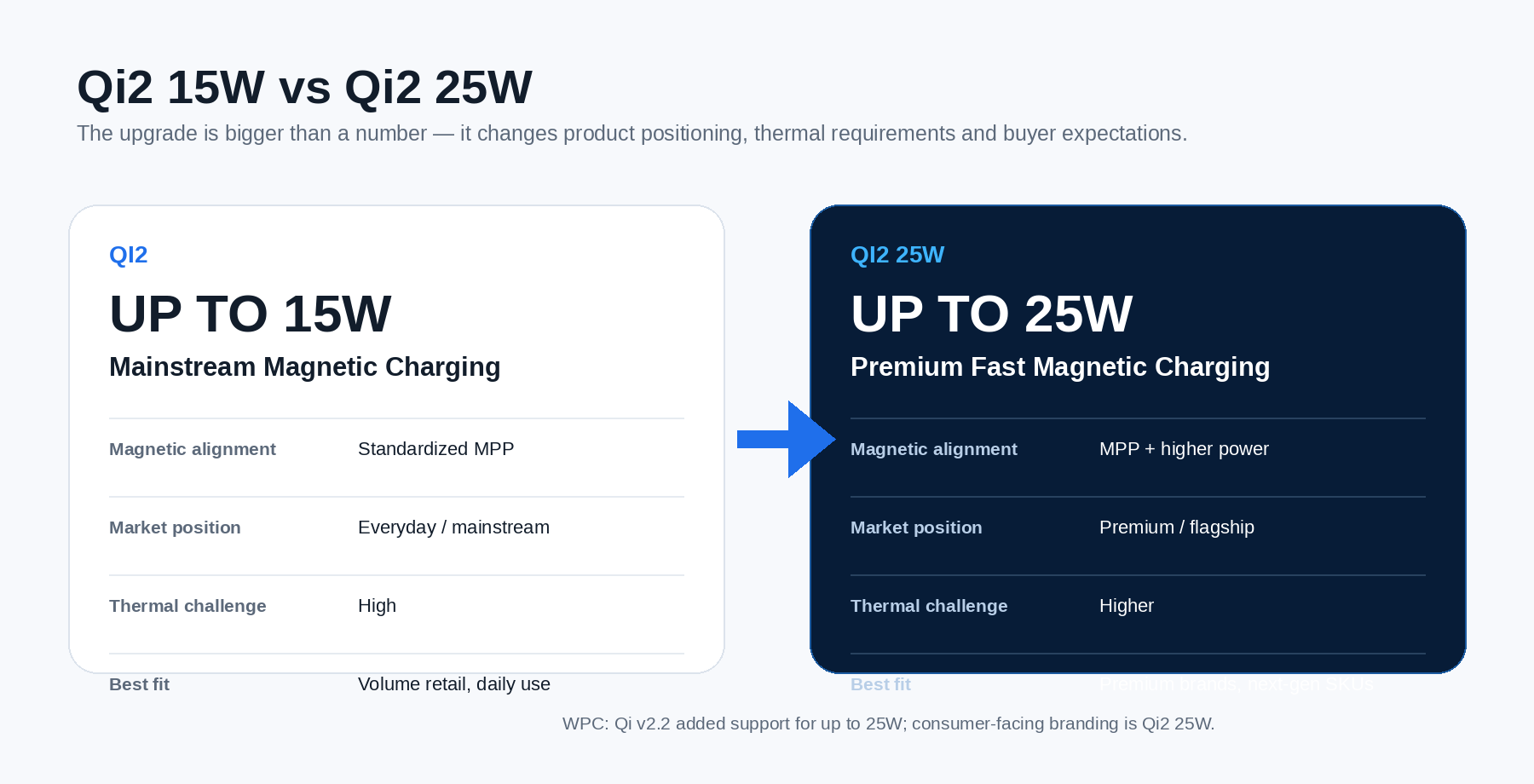
Figure: Qi2 15W vs Qi2 25W — technical upgrade and market positioning.
Is 25W Wireless Charging Really Faster?
On a compatible phone and under suitable charging conditions, yes. Qi2 25W increases the available wireless charging ceiling versus the original 15W Qi2 platform. WPC describes Qi2 25W as delivering nearly 70% more charging power than original Qi2, and notes that a compatible smartphone can reach roughly 0–50% in about 30 minutes under appropriate conditions.
However, professional buyers should treat “25W” as a maximum capability, not a guarantee that every phone will continuously receive 25W. Actual charging performance depends on the smartphone, battery state of charge, temperature, ambient environment, phone case, magnetic alignment, firmware, internal power management and thermal design.
Professional Insight
B2B buying rule: evaluate charging curves and temperature behavior, not only the maximum wattage printed on the specification sheet.
Explore HSONE ProductsDoes Qi2 25W Generate More Heat?
Heat is one of the biggest concerns in current user discussions. Wireless charging naturally has conversion losses, and some energy becomes heat instead of stored battery energy. At higher power levels, thermal engineering becomes even more important. A well-designed product balances charging speed with temperature control instead of chasing a headline number.
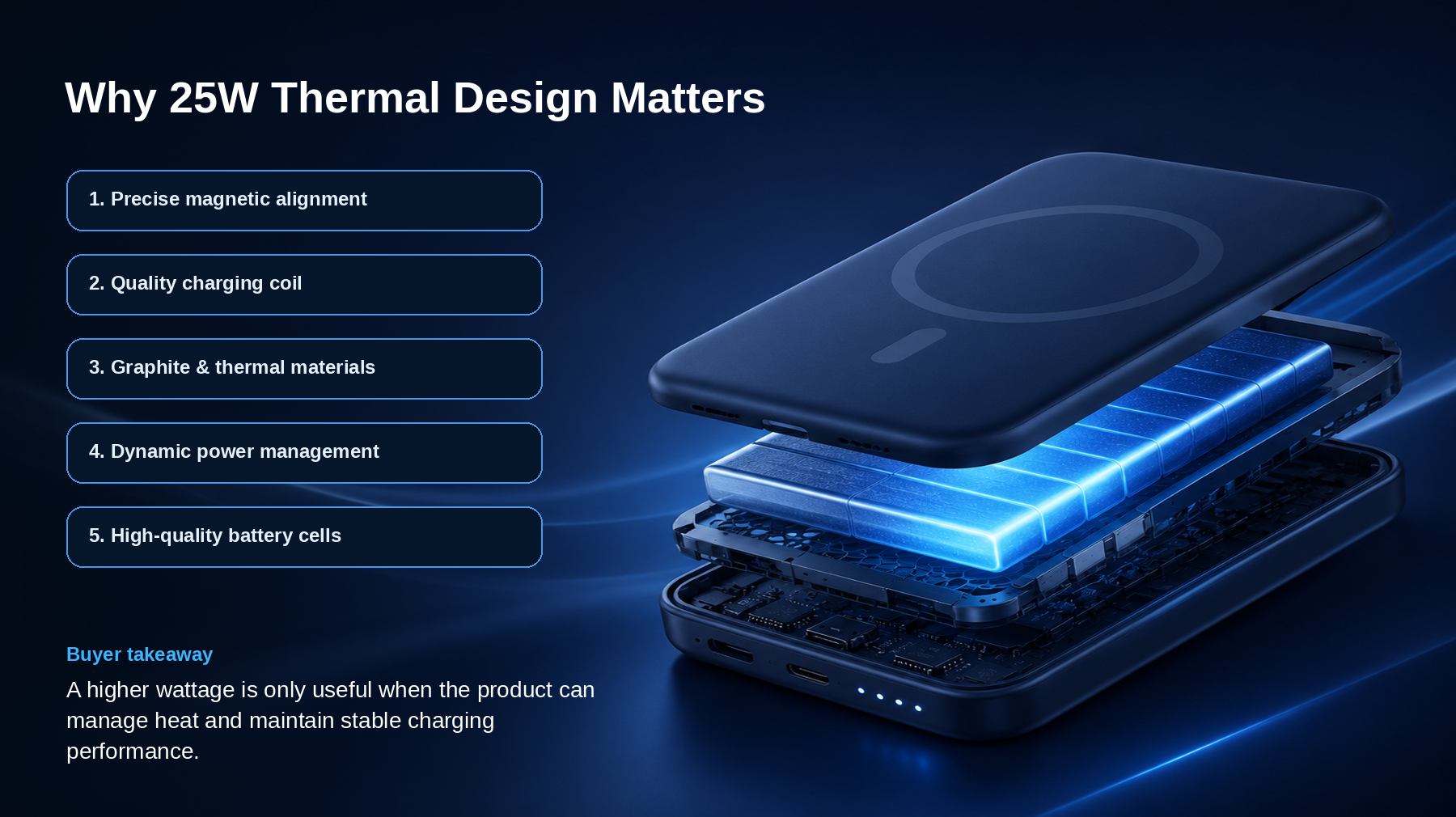
Figure: Thermal management becomes a key differentiator as magnetic wireless power increases.
- Accurate magnetic alignment to reduce unnecessary energy loss
- High-quality coils and power electronics
- Graphite sheets, thermal pads and heat-spreading structures
- Dynamic power management and temperature-based throttling
- Reliable battery cells and multiple protection layers
Does a Phone Case Affect Qi2 Charging?
Yes. A thick or poorly designed case can increase the distance between charging coils or shift the magnetic alignment. That can reduce charging speed, weaken magnetic holding force, increase temperature or cause charging interruptions. For B2B validation, test both bare phones and representative magnetic-compatible cases from the target market.
5000mAh vs 10000mAh: Which Capacity Is Better?
There is no universal winner. The correct capacity depends on product positioning. A 5000mAh magnetic power bank is attractive when slimness, weight and everyday carry are the priority. A 10000mAh model is better suited to travel, heavy users and customers who value more usable energy over minimum thickness.
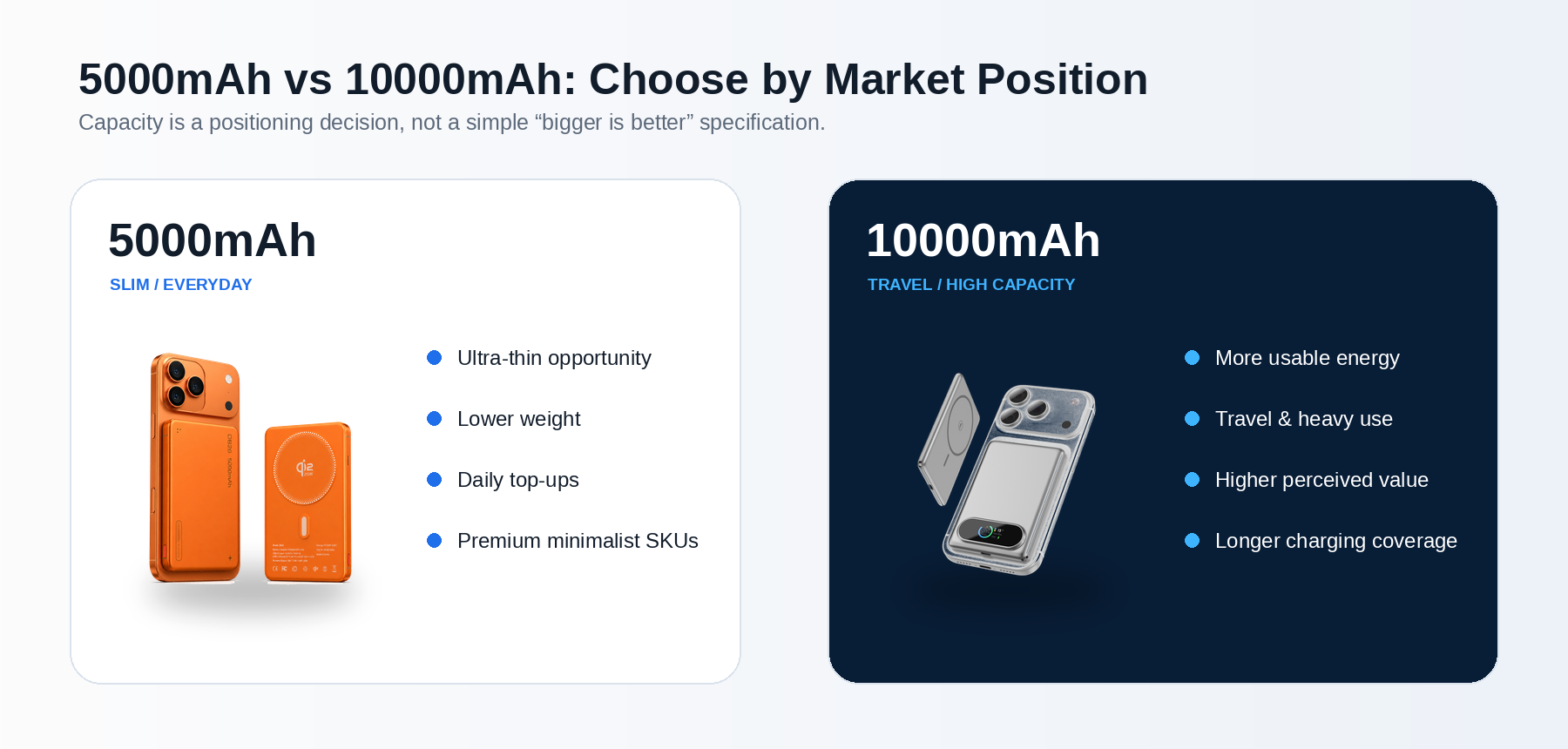
Figure: Position 5000mAh as slim/everyday and 10000mAh as travel/high-capacity.
| Target Customer | Recommended Direction | Commercial Story |
|---|---|---|
| Apple accessory retailer | Premium 5000mAh ultra-thin | Thin, light, premium everyday carry |
| E-commerce brand | 5000mAh + 10000mAh | Good / better product ladder |
| Travel accessory brand | 10000mAh | More power for trips and heavy use |
| Consumer electronics brand | Full capacity range | Build a complete magnetic ecosystem |
| Distributor / high-volume retail | Multiple price points | Cover mainstream and premium segments |
Qi2 vs MagSafe: What Buyers Should Know
Consumers still search for phrases such as “MagSafe power bank,” “MagSafe battery pack” and “magnetic power bank for iPhone.” Those keywords are commercially valuable, but B2B buyers should distinguish general magnetic compatibility from official Qi certification. A product described as “Qi2 compatible” is not automatically the same as a Qi2 Certified product.
Why Official Qi Certification Matters
WPC states that Qi Certified products must pass testing for safety and interoperability at an authorized laboratory before they are permitted to display the relevant Qi logo. For brands and distributors, certification improves technical verification, retail credibility and procurement confidence. Buyers should verify the product in the WPC certified-product database where applicable rather than relying only on a logo shown in a sales presentation.
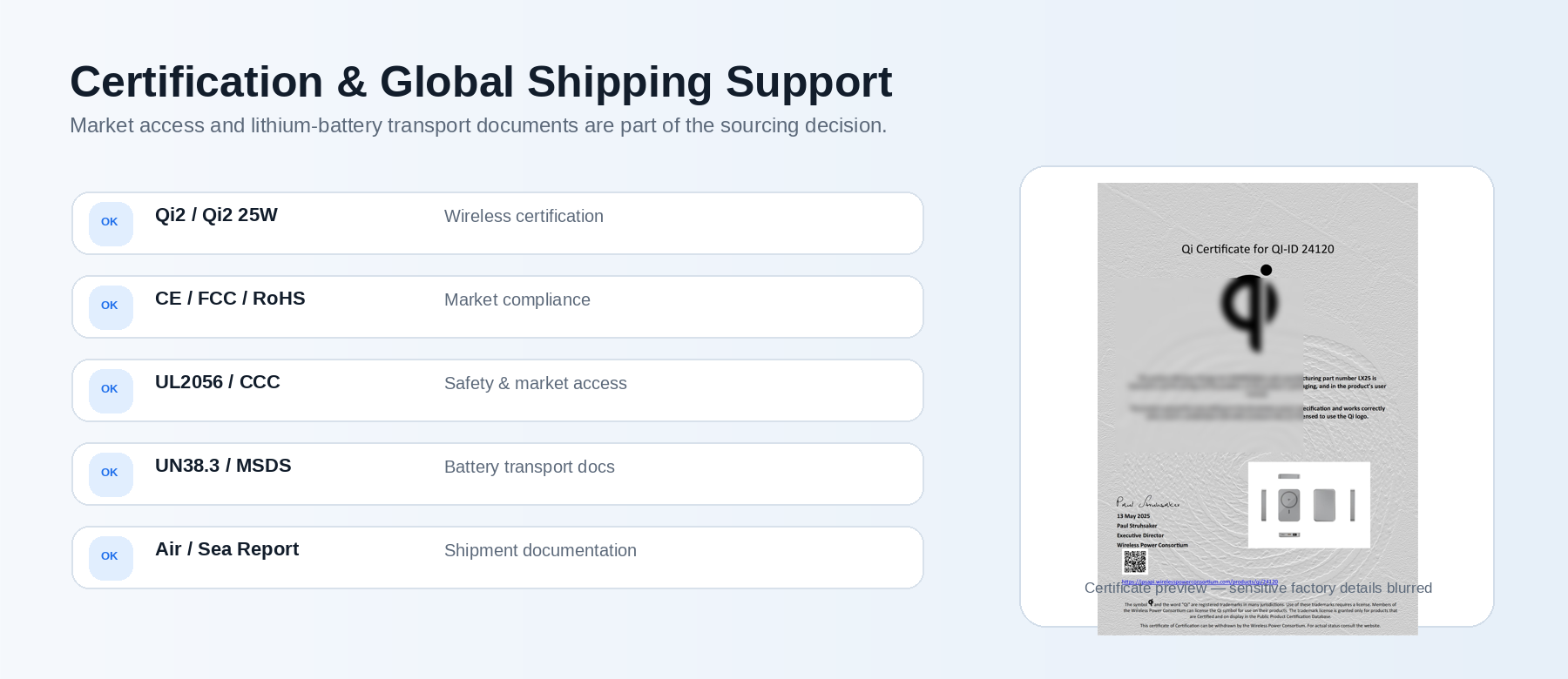
Figure: Certification and transport documentation reduce market-access and shipping risk.
B2B Buyer Checklist: What to Ask a Qi2 Power Bank Supplier
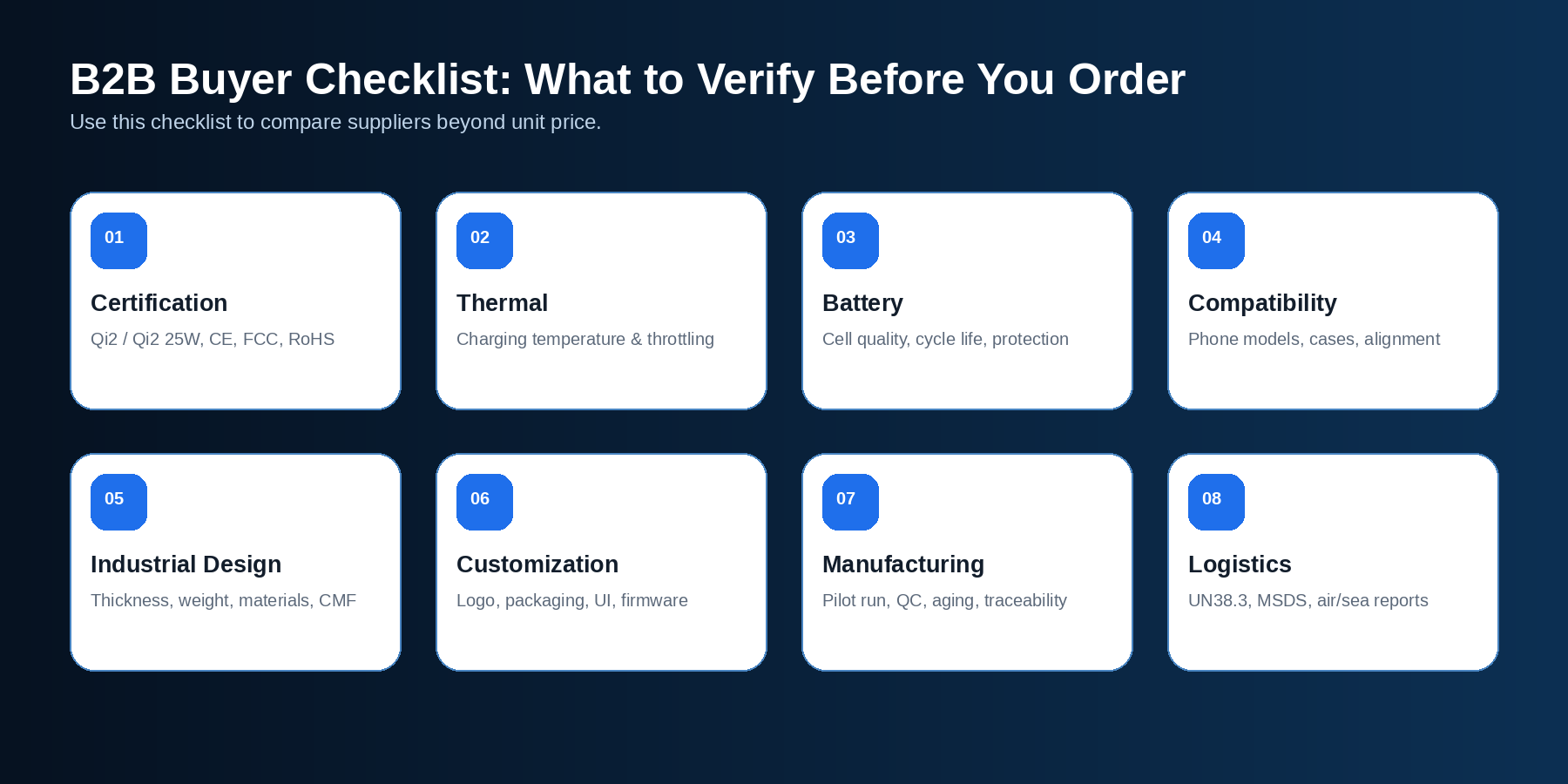
Figure: Use the checklist below before placing a mass-production order.
- Is the model officially Qi2 or Qi2 25W Certified?
- Which smartphone models and cases have been tested?
- What is the charging-temperature profile under defined conditions?
- What battery cells, cycle-life target and protection functions are used?
- What is the actual thickness, weight and magnetic force?
- Which CE, FCC, RoHS, UL2056, CCC or other market documents are available for the project?
- Can the supplier provide UN38.3, MSDS and relevant air/sea transportation documentation?
- Can logo, color, packaging, TFT interface, firmware or structure be customized?
- What are sample lead time, MOQ, mass-production lead time and QC standards?
- Can the supplier support private-mold development and market differentiation?
What Product Features Are Growing in the Magnetic Power Bank Market?
Qi2 25W fast wireless charging: A premium charging story for compatible devices.
Ultra-thin design: Thickness is one of the strongest visual selling points for a magnetic battery.
Semi-solid battery platforms: Battery safety can become a visible product differentiator rather than an invisible component.
Smart TFT display: Battery percentage, charging status, temperature, output and custom UI can create stronger e-commerce visuals.
Built-in USB-C cable: Combines magnetic convenience with a wired backup option.
Integrated stand: Adds desk, video-call and travel utility.
Higher USB-C output: Makes the product useful beyond wireless phone charging.
Which HSONE Product Platform Fits Your Market?
Instead of forcing every buyer into one “best” model, HSONE organizes magnetic power banks by market position and feature story. The same model can appear in multiple collections when it answers more than one buyer need.
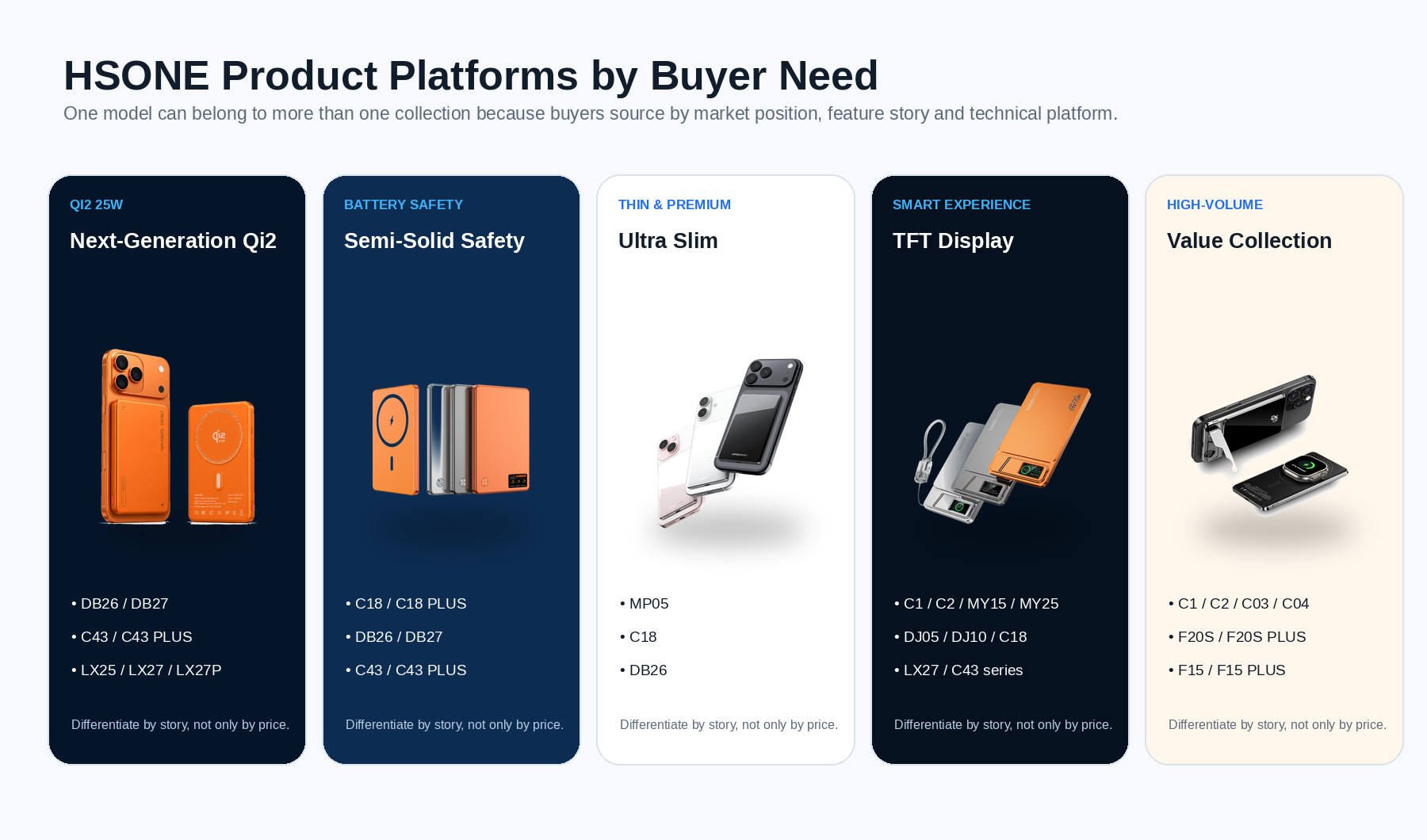
Figure: Five product lines support premium, safety, slim, smart-display and high-volume market strategies.
Next-Generation Qi2 Collection
Models: DB26, DB27, C43, C43 PLUS, LX25, LX27 and LX27P
Best for premium accessory brands, Apple-oriented retail, technology channels and high-end e-commerce.
Semi-Solid Safety Battery Collection
Models: C18, C18 PLUS, DB26, DB27, C43 and C43 PLUS
Best for brands that want a stronger battery-safety and technology-differentiation story.
Ultra-Slim Collection
Best for premium lifestyle brands, Apple accessory channels and minimalist everyday-carry products.
Smart TFT Display Collection
Models: C1, C2, MY15, MY25, DJ05, DJ10, C18, C18 PLUS, LX27, LX27 PLUS, C43 and C43 PLUS
Best for e-commerce and technology brands that need visible user-experience differentiation.
Value Collection
Models: C1, C2, C03, C04, F20S, F20S PLUS, F15 and F15 PLUS
Best for distributors, high-volume retail and price-sensitive projects that still require reliable performance.
Not Sure Which Model Fits Your Market?
Start with the market, not the catalog. Send HSONE your target country and required capacity, and we'll recommend the best platform for your launch strategy.
Request a Product RecommendationWhat OEM/ODM Customization Is Available?
For B2B customers, selecting an existing product is only one option. Depending on the model and project scope, customization can include logo, color and CMF, retail packaging, accessories, TFT screen graphics, firmware, structural modification, industrial design and private-mold development.
A strong ODM project should connect product engineering with commercial positioning: the goal is not only to make a different shell, but to create a model that has a clearer reason to exist in the target channel.
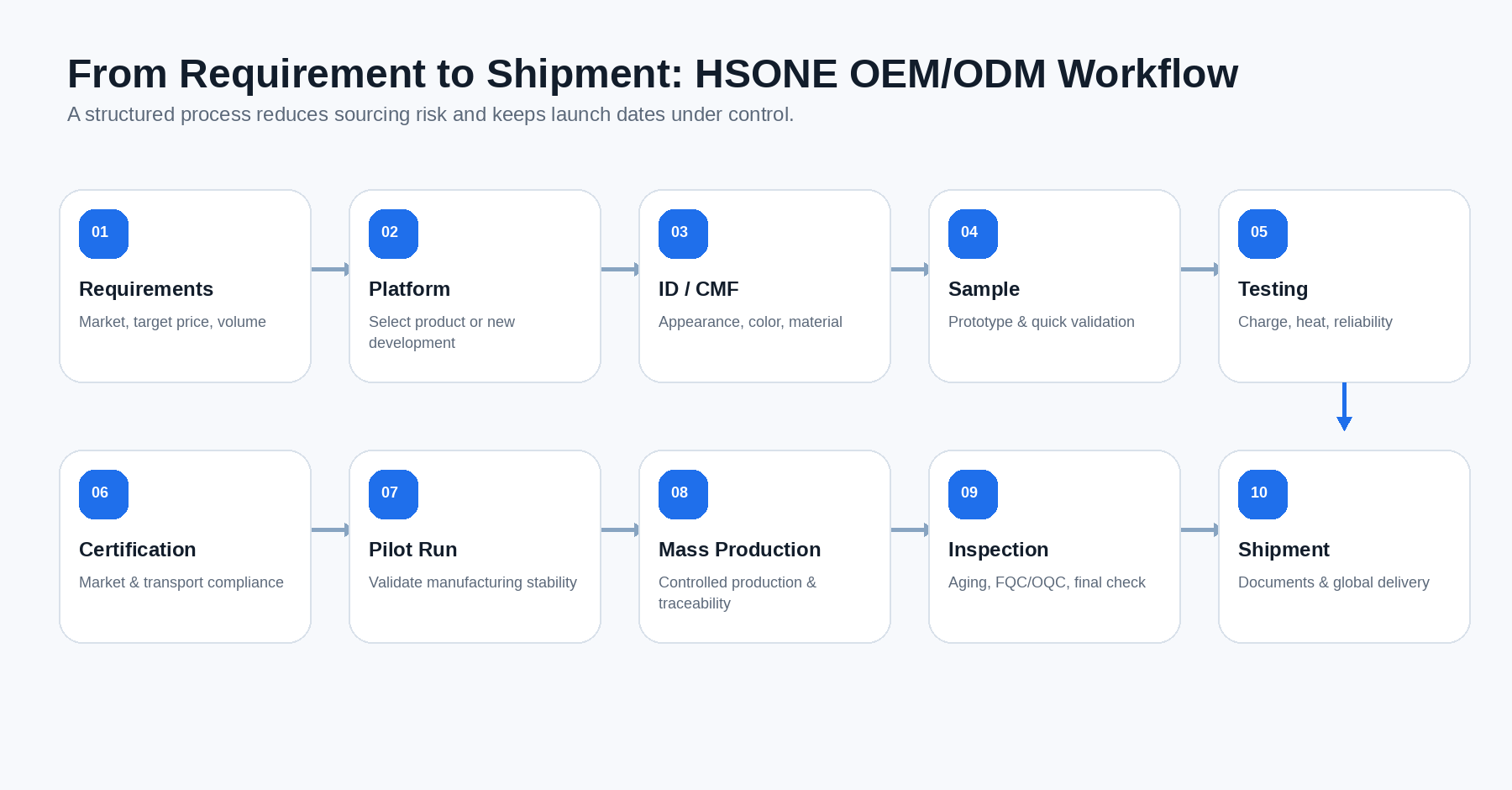
Figure: A structured OEM/ODM workflow helps control risk, quality and launch timing.
How Fast Can a Magnetic Power Bank Sample Be Made?
For selected existing HSONE platforms with standard customization, qualified projects can support approximately 3–7 day sample preparation depending on requirements. Completely new private-mold projects take longer because industrial design, structure, electronics, tooling, testing and certification must be coordinated before production.
Price Is Important — But Total Sourcing Risk Matters More
The cheapest quotation does not always create the lowest total cost. A small unit-price saving can be erased by poor charging performance, battery defects, certification problems, unstable cosmetic quality, shipment delays or high return rates.
Unit Price + Reliability + Certification + Lead Time + Quality Control + Market Differentiation + Supply Stability
Why Brands Work With HSONE
HSONE focuses on magnetic power banks and mobile charging accessories for international B2B customers. Available capabilities include Qi2 / Qi2 25W platforms, OEM/ODM customization, private mold development, premium aluminum and ultra-thin designs, semi-solid battery options, TFT smart displays, certification support, fast sampling, quality control and international shipping documentation.
Frequently Asked Questions
Is Qi2.2 the same as Qi2 25W?
In industry conversation, “Qi2.2” is commonly used for the newer generation. WPC documents list Qi v2.2 as adding support for up to 25W, while the consumer-facing brand is Qi2 25W.
Is Qi2 25W faster than Qi2 15W?
Yes, on compatible devices and under suitable conditions, Qi2 25W provides a higher wireless charging ceiling than original Qi2.
Does every Qi2 25W phone charge at 25W all the time?
No. Actual power depends on the phone, temperature, battery percentage, case, alignment, firmware and charging conditions.
Does Qi2 wireless charging get hot?
Wireless charging naturally creates some heat. Product design, alignment, power management and thermal materials determine how well it is controlled.