Semi-solid battery technology is moving from EV headlines into consumer power banks. For B2B buyers, the opportunity is real — but so is the risk of overclaiming. This guide explains what the technology can improve, what still needs validation, and how to source it responsibly.
Battery safety has become one of the most important purchasing questions in the power bank market. Buyers increasingly ask about heat, swelling, charging cycles, airline transport and what happens if a cell is mechanically damaged.
That is why “solid-state” and “semi-solid-state” power banks are suddenly showing up in product launches, Reddit discussions and premium accessory catalogs. The idea is attractive: reduce the amount of free liquid electrolyte inside the cell, improve stability, and create a safer battery platform for products that people carry in pockets, bags and airplanes.
But the terminology is easy to misuse. A semi-solid battery is not the same as an all-solid-state battery, and a safer electrolyte system does not make a power bank automatically fire-proof, cool-running or airline-approved.
For brands, distributors and retailers, the better question is not “Is semi-solid better?” It is: “Does this battery platform create enough safety, lifecycle and product-positioning value for my target market — and can the supplier prove the claims?”
What Is a Semi-Solid-State Battery?
Conventional lithium-ion cells typically use an organic liquid electrolyte to move lithium ions between the positive and negative electrodes. Semi-solid or gel-like systems reduce the free-liquid portion by immobilizing electrolyte within a polymer, gel or hybrid solid-liquid matrix.
This matters because liquid electrolyte is one of the components involved in leakage, flammability and thermal-runaway behavior. Research on gel polymer electrolyte systems has shown that the right material design can improve thermal stability and reduce some safety risks while preserving useful ionic conductivity.
However, “semi-solid,” “quasi-solid,” “gel polymer” and “solid-state” are not interchangeable marketing labels. The exact chemistry, percentage of liquid, electrode system and cell construction vary by manufacturer.
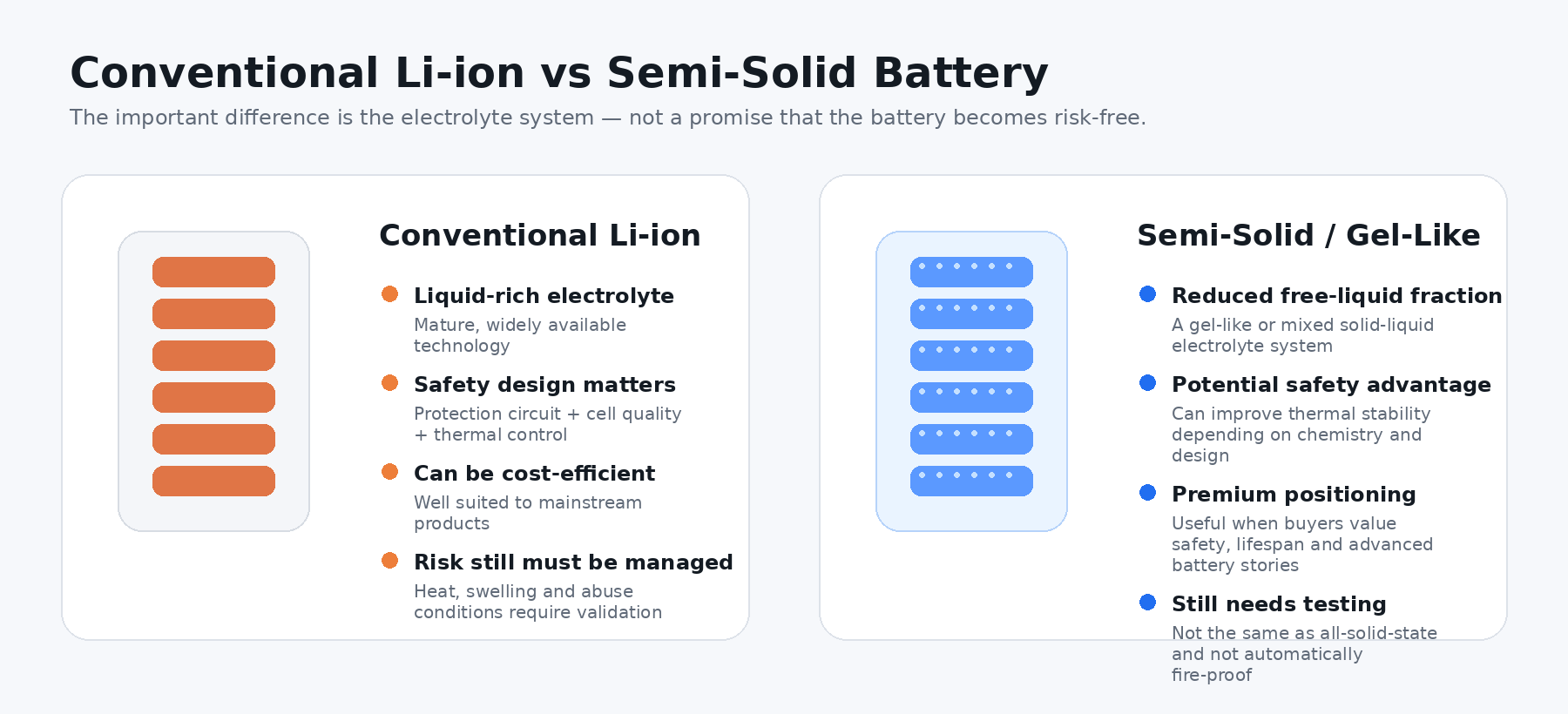
Visual guide: the key difference is the electrolyte system, not the absence of all battery risk.
Research Note
A 2024 comparative study reported slower temperature rise during thermal runaway for the semi-solid cells it tested. The lesson for buyers: semi-solid can improve the safety envelope, but it does not eliminate the need for testing.
Why Buyers Are Suddenly Interested in Semi-Solid Power Banks
Current online discussions show that buyers are not simply chasing a new battery buzzword. They are asking practical questions: Is it safer? Does it run cooler? Is it worth paying more? Will it last longer? Is it suitable for flights?
Recent Reddit threads about semi-solid power banks are notably skeptical in a healthy way. Some users are excited about the possibility of better safety and cycle life. Others report that semi-solid packs still feel warm in normal use. That is exactly the mindset B2B buyers should adopt.
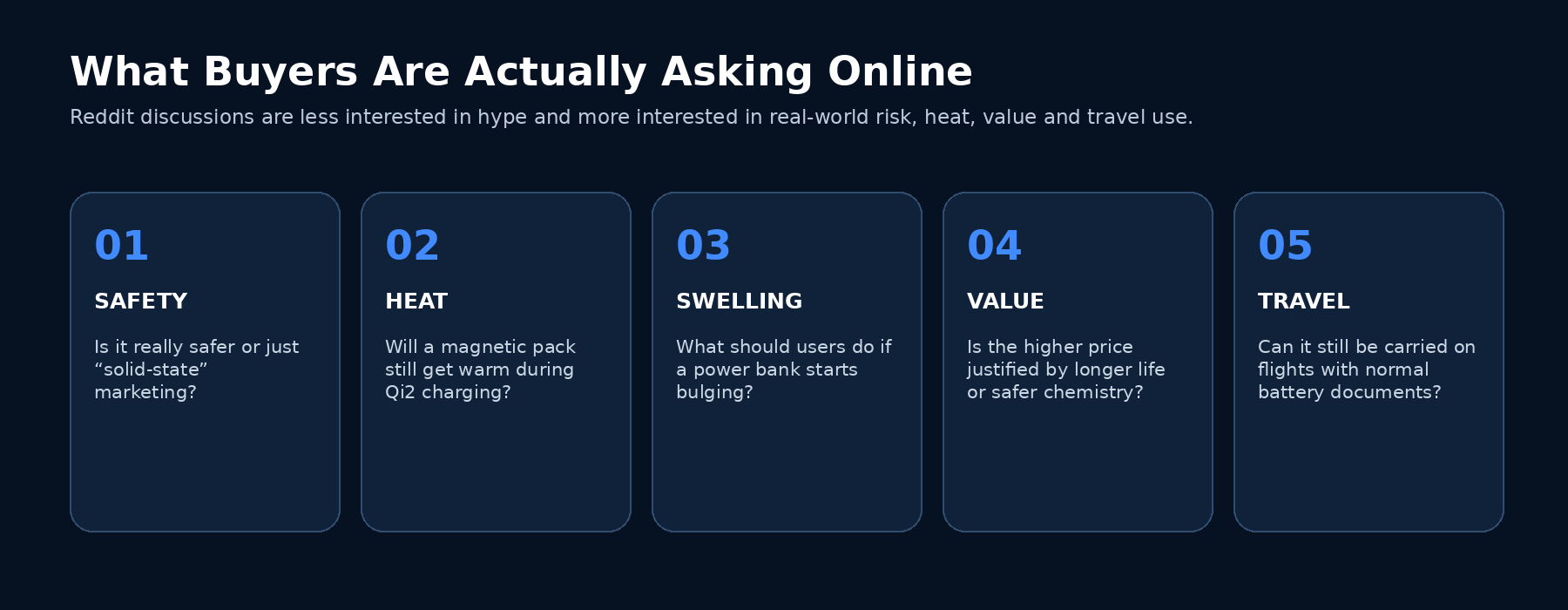
Figure: Real user feedback highlighting heat and speed expectations.
Are Semi-Solid Power Banks Actually Safer?
Potentially, yes — if the cell chemistry and product design are genuinely different and properly validated.
Gel and semi-solid electrolyte systems can reduce the amount of freely flowing flammable solvent and can improve thermal or dimensional stability. Laboratory research has demonstrated that nonflammable and low-reactivity gel polymer electrolyte designs can materially reduce heat-generating reactions under abuse conditions.
But “safer” is a relative engineering claim. It should never be translated into statements such as “cannot catch fire,” “cannot swell,” or “safe under any puncture.” A finished power bank still contains electrochemically active materials, stored energy, connectors, charging electronics and mechanical structures that must work together safely.
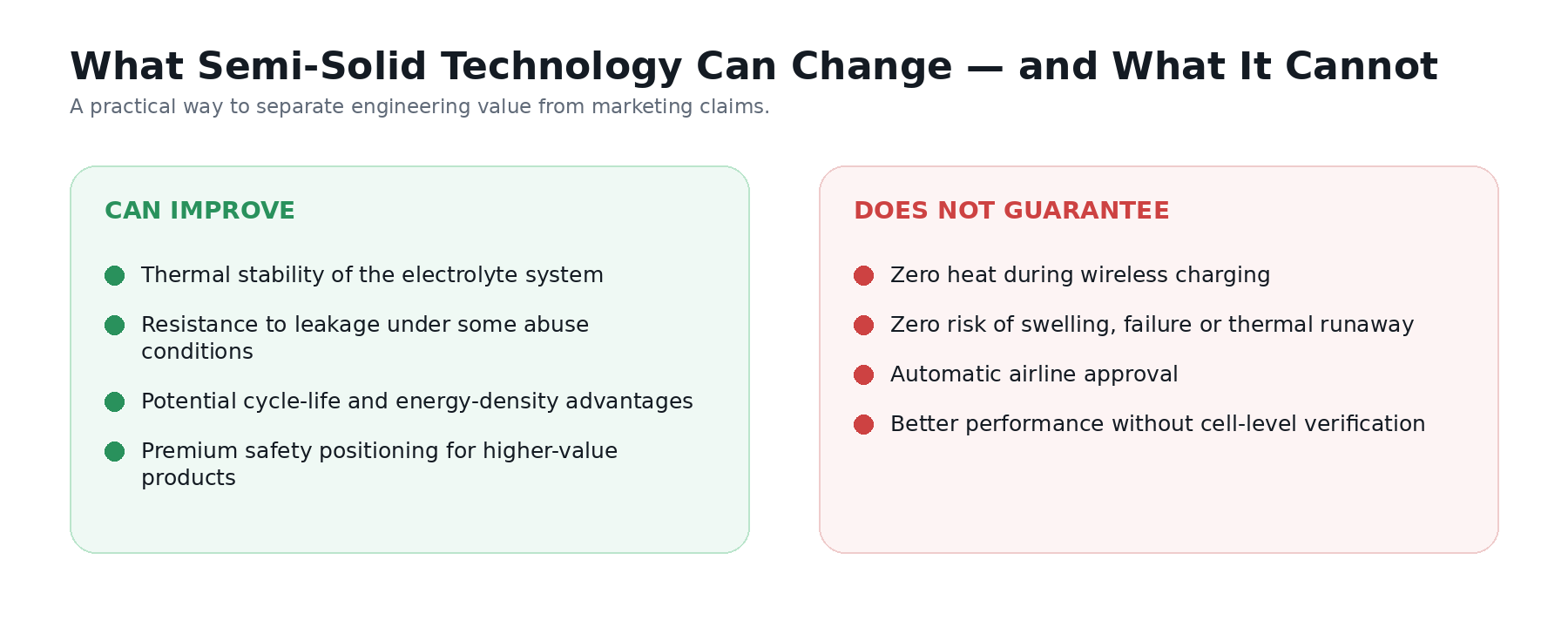
Figure: Understanding the difference between relative safety improvements and absolute marketing claims.
What a Responsible Supplier Should Prove
- Cell specification and supplier traceability rather than only a “semi-solid” label.
- Capacity, charge/discharge and cycle testing for the actual cell used in production.
- Thermal behavior under wired charging and magnetic wireless charging.
- Protection performance for overcharge, over-discharge, short circuit and temperature events.
- Mechanical abuse and reliability testing appropriate to the product design.
- UN38.3, MSDS and transportation documentation for the actual battery configuration.
Does Semi-Solid Mean a Magnetic Power Bank Will Run Cool?
No. This is one of the most important myths to avoid. Heat during use is not created by the battery electrolyte alone. Magnetic wireless charging introduces conversion losses in the transmitter coil, receiver coil, power electronics and surrounding structures.
A semi-solid cell may offer a better safety margin at the cell level, but a poorly designed Qi2 magnetic system can still become uncomfortable to the touch or reduce charging speed when temperature rises.
B2B Sourcing Tip
Ask for temperature curves under the exact charging modes you plan to advertise: wireless, USB-C wired, and representative phone-case conditions.
View HSONE Testing CapabilityWhere Semi-Solid Battery Technology Fits in a Premium Portfolio
Semi-solid battery technology is most commercially useful when it supports a clear market story. For premium magnetic products, the strongest combinations are often safety + slimness, safety + Qi2 fast wireless charging, or safety + smart display.
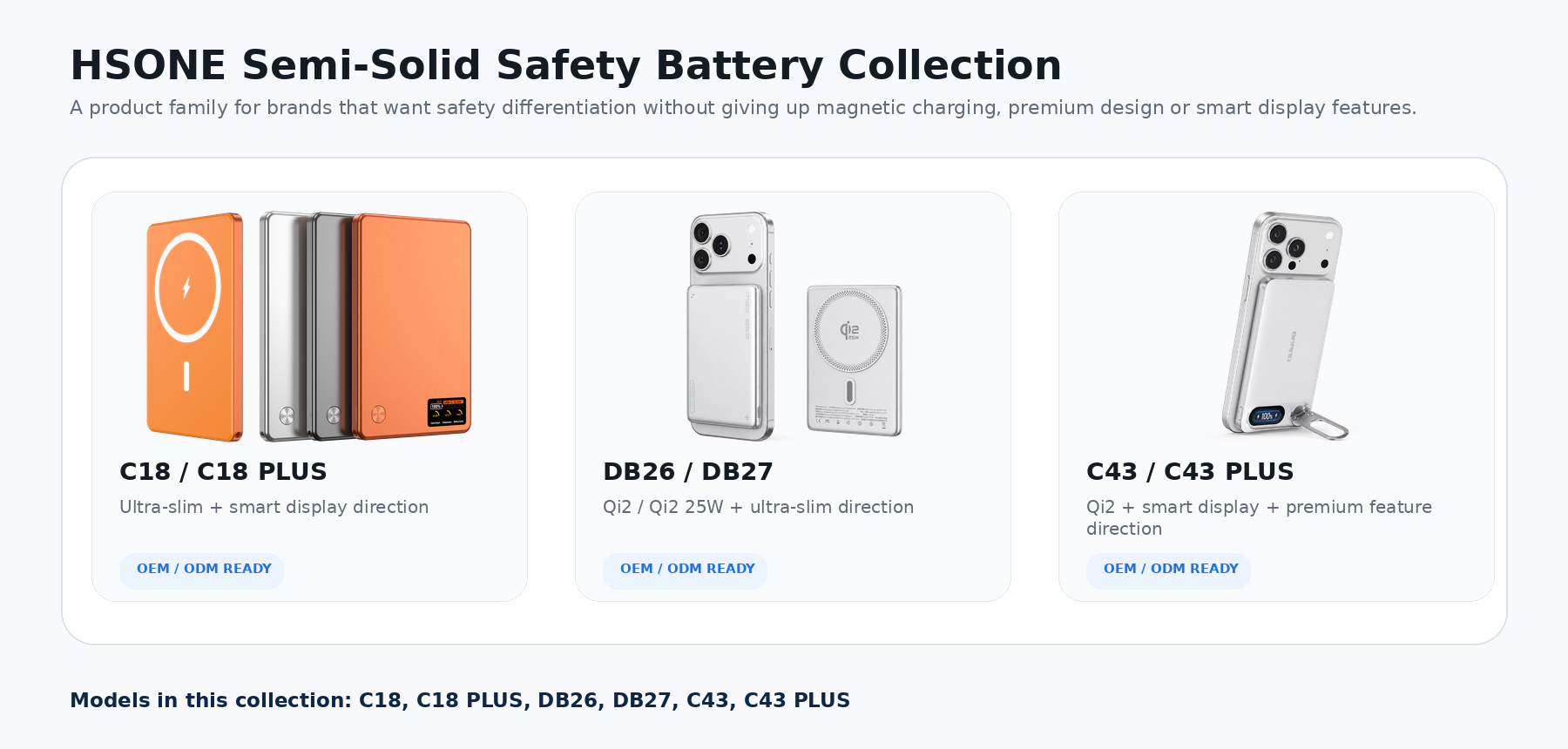
Figure: HSONE groups models C18, DB26, and C43 under the semi-solid safety platform.
HSONE Semi-Solid Safety Battery Collection
- C18 / C18 PLUS — suitable for ultra-slim and smart-display positioning.
- DB26 / DB27 — suitable for Qi2 / Qi2 25W, ultra-slim and safety-focused premium positioning.
- C43 / C43 PLUS — suitable for buyers who want Qi2, smart display and a more feature-rich premium story.
|
Need the right semi-solid platform for your market? Compare HSONE product collections → |
Is the Higher Cost Worth It for B2B Buyers?
Sometimes. The right answer depends on channel economics. Semi-solid battery technology can justify a higher bill of materials when it helps a brand achieve a higher retail price, reduce safety objections, or support a premium warranty story.
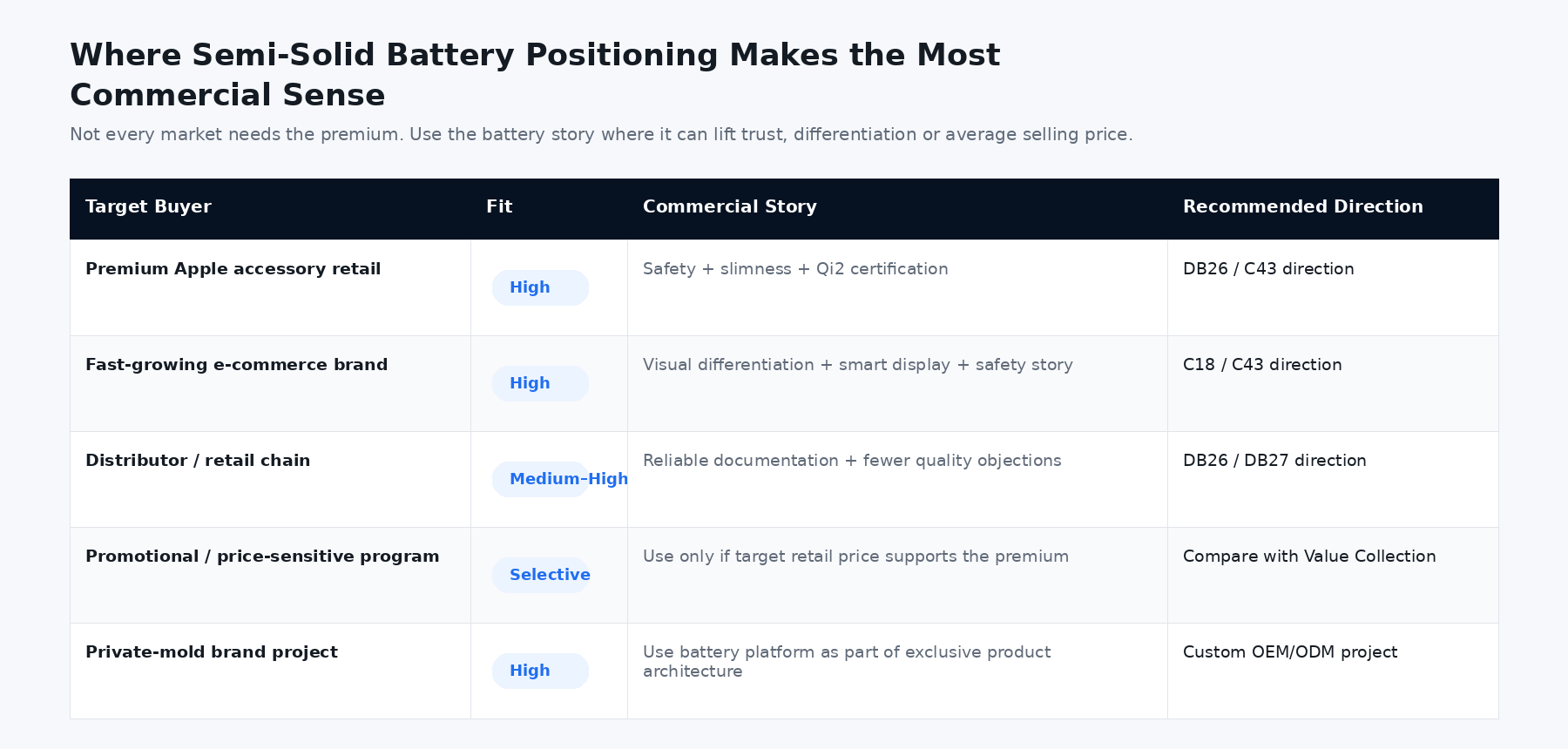
Figure: Choosing the right battery platform based on product positioning and channel needs.
B2B Buyer Checklist: How to Evaluate a Semi-Solid Power Bank Supplier
- Ask what “semi-solid” means for that exact cell: Request chemistry and construction information.
- Ask for evidence, not only demonstration videos: Puncture videos do not replace standardized testing.
- Verify the complete charging system: Evaluate coil alignment and thermal behavior.
- Check mass-production consistency: Ask how cells are incoming-inspected and lots are tracked.
- Match certifications to the actual market: CE, FCC, RoHS, CCC or other market documents.
- Check transport documentation: UN38.3, MSDS, air-transport and sea-transport reports.
- Evaluate supplier engineering support: Supplier should support ID, PCB, firmware and testing.
How HSONE Validates a Semi-Solid Battery Product
A battery-safety story is credible only when the whole development process supports it. A practical validation path looks like this:
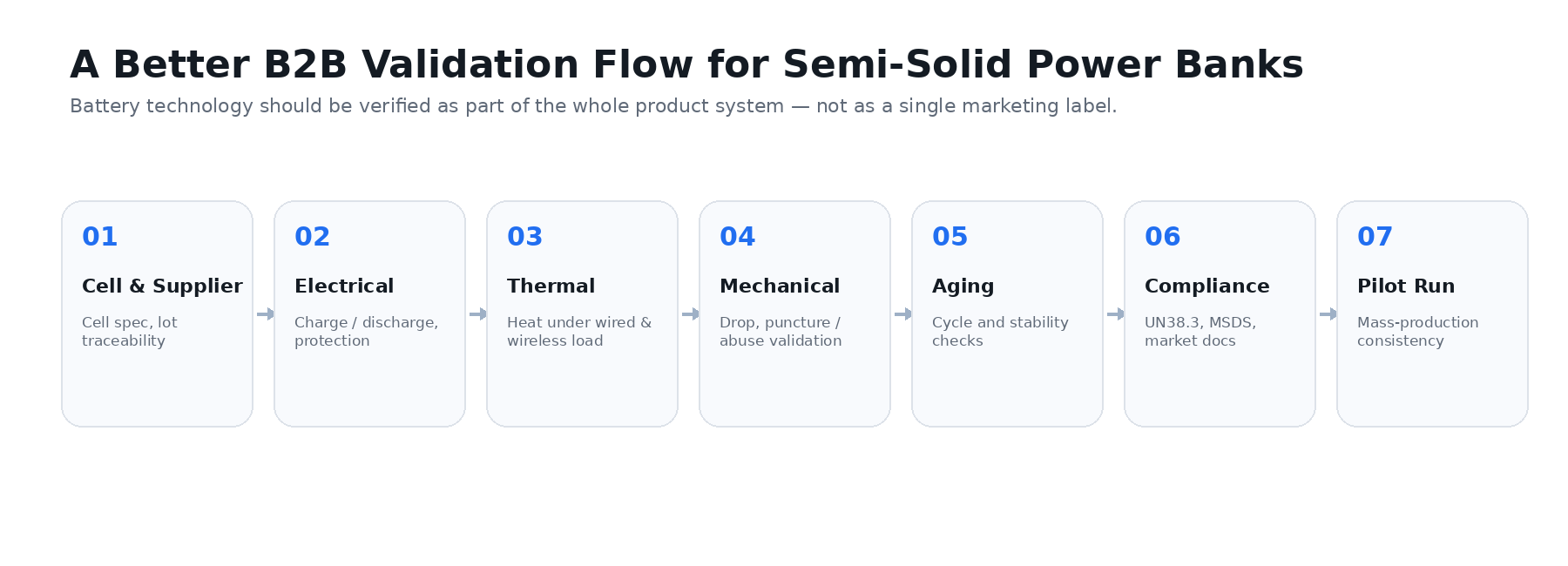
Figure: A structured validation workflow from cell selection to global shipping compliance.
HSONE’s manufacturing and compliance pages already present battery performance testing, aging, drop testing and global transportation documentation as part of the buyer-facing quality story.
Are Semi-Solid Power Banks Easier to Take on Flights?
The battery chemistry does not remove normal aviation rules. Airline and regulatory requirements are based on battery energy (Wh), transport classification, and carrier carriage rules.
For international B2B shipments, the practical focus remains proper documentation. HSONE supports projects with UN38.3, MSDS, and air/sea transport reports to ensure compliant logistics.
| Capacity | Best Positioning | Typical Channel Fit |
|---|---|---|
| 5000mAh | Ultra-slim / daily carry | Apple accessory, premium retail, executive travel |
| 10000mAh | Higher-capacity / travel | E-commerce, travel retail, heavy smartphone users |
How to Market Semi-Solid Battery Technology Without Overclaiming
| Recommended wording | High-risk wording |
|---|---|
| Semi-solid battery platform designed to improve safety and thermal stability. | Fire-proof battery. Impossible to explode. |
| Validated through defined battery safety and reliability tests. | Safe under any damage condition. |
| Premium battery platform with reduced free-liquid electrolyte. | True all-solid-state battery (unless it actually is one). |
Why the Manufacturer Matters More Than the Battery Buzzword
Battery chemistry is only one layer of the final product. A premium magnetic power bank also depends on industrial design, coil alignment, PCB design, thermal materials, firmware, assembly and inspection.
That is why a B2B buyer should compare total product engineering rather than selecting the supplier with the most aggressive “solid-state” claim.
Frequently Asked Questions
Is a semi-solid battery the same as a solid-state battery?
No. Semi-solid systems still contain some liquid or gel-like electrolyte. All-solid-state batteries aim to eliminate liquid electrolyte entirely.
Are semi-solid power banks safer than normal lithium-ion power banks?
They can offer safety advantages depending on the cell chemistry and design, but they are not risk-free. Buyers should verify test data for the exact model.
Can semi-solid power banks still get hot?
Yes. Wireless charging, power electronics and the battery itself can all generate heat. A better cell does not remove the need for thermal engineering.
Can a semi-solid battery still swell?
Battery swelling or gas generation is still possible under certain failure or aging conditions.